VerantwortungohneZugriff
How leadership holds when responsibility grows and direct control is no longer enough. A German-language book.
Leon Köllerwirth Hlihel · Non-fiction · Paperback and Kindle eBook
By day it is three flights of stairs from my desk to the factory floor. At night the stairs are still there. I am just not at the top of them.
The larger responsibility becomes, the less of it you can see, decide and correct yourself. People decide for themselves. Teams work without me. Systems run at night. Other departments do not report to me. The responsibility stays.
This book does not begin with a model. It begins with a label printer that fails at night, and with the question of who the problem actually belongs to. From there it moves through people and teams to systems and organisations – to commitments, handovers, trust, architecture, boundaries and decisions that have to hold even when I am not in the room.
Paperback €23.43 · Kindle €8.99. 146 pages in German, read in one evening.

- You led a team, and now you lead people who lead teams themselves.
- You are responsible for systems that run at night, and you hear about failures the next morning.
- In areas that do not report to you, you still have to get things done.
- Was nachts ausfallen kann, braucht vor der nächsten Nacht einen Namen.
- Ganze Ergebnisse übergeben, keine Arbeitsschritte.
- Wer eine Architektur verantwortet, liest weiter Code.
In the book, each rule stands in the situation it came from, with its conditions and limits. The rules are in German.
Six parts, 15 chapters (titles in German).
- Prolog – Der Moment, in dem Zugriff nicht mehr reicht
- Teil I · Das Problem
- Verantwortung bleibt
- Der Radius wächst
- Der Flaschenhals trägt einen Namen
- Teil II · Menschen
- Menschen sind keine verlängerten Arme
- Vertrauen ist keine Charakterfrage
- Teil III · Teams
- Ein Team ist kein größerer Mensch
- Führung beginnt dort, wo ich nicht dabei bin
- Teil IV · Systeme
- Was vorhersehbar ist, beginnt nicht bei der Person
- Wem gehört es um drei Uhr morgens?
- Transparenz ersetzt Kontrolle nicht, aber sie macht sie gezielt
- Teil V · Organisation
- Verantwortung ohne Weisungsrecht
- Drei Häuser, dieselbe Entscheidung
- Teil VI · Konsequenz
- Die Entscheidung muss ohne mich halten
- Verantwortung endet nicht an der eigenen Grenze
- Wenn Führung funktioniert, werde ich weniger sichtbar
- Wo diese Erfahrungen an Forschung anschließen
- Die Sätze, die geblieben sind
In der Nachtschicht fällt im Lager einer der Etikettendrucker aus.
Das ist kein Totalausfall. Es gibt noch einen zweiten Drucker. Nur steht der an einer anderen Stelle, und von diesem Moment an läuft alles über ihn. Die Kollegen tragen Aufträge hin und Etiketten zurück, Wege werden länger, Arbeit wartet.
Das Lager kann weitermachen.
Nur nicht mehr so, wie es soll.
Also ruft die Schicht beim IT-Service an.
Der Drucker hängt im zentralen Drucknetzwerk. Die IT prüft, was sie aus der Ferne prüfen kann. Das Gerät ist erreichbar. Druckaufträge kommen an. Auf den ersten Blick sieht es deshalb nicht nach einem Netzwerk- oder Softwareproblem aus.
Also wird die Instandhaltung dazugenommen.
Auch dort versucht man, die Sache am Telefon einzugrenzen. Die Schicht beschreibt, was sie sieht, jemand lässt etwas öffnen, schließen, neu starten. Das Übliche.
Nur geht in dieser Nacht niemand von beiden tatsächlich in die Halle.
Irgendwann ist technisch erstaunlich viel geklärt.
Der Drucker ist im Netz.
Die Software schickt Druckaufträge.
Das Gerät ist nicht offensichtlich defekt.
Es druckt nur keine Etiketten.
Für die Kollegen im Lager ist diese Differenzierung vermutlich von begrenztem Trost.
Sie arbeiten mit dem zweiten Drucker weiter.
Am nächsten Morgen erfahre ich davon.
Ich gehe die drei Treppen hinunter in die Halle.
Leon Köllerwirth Hlihel started as a software developer in 2004 and spent twelve years at an industrial company with several plants, finally as head of development. Enterprise architecture and information security in a large group followed, most recently four years as Chief Product Owner on mandate. The situations in the book come from this work; companies and people are not named.
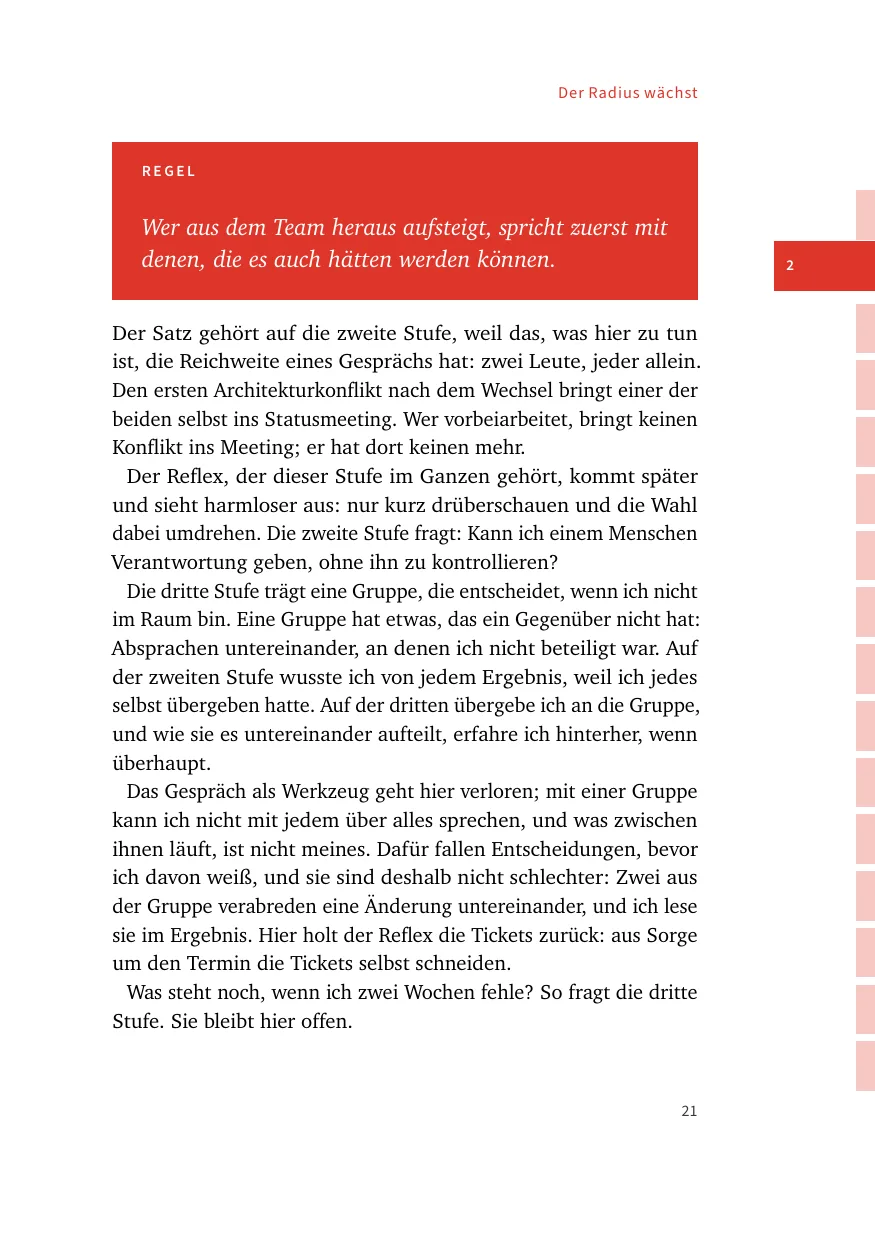
Two pages from the typeset book, A5. Blue opens a part, red opens a chapter and carries each of the 21 rules.

A chapter begins: the whole page in red, number and title at the foot. The text starts opposite.
Each rule stands where it arises: a red box in the middle of the chapter, the sentence in white italics.
Published as a paperback and Kindle eBook on Amazon. Questions about the book, readings and conversations: by email.
Paperback €23.43 · Kindle €8.99. 146 pages in German, read in one evening.